The inaugural Business Innovation Survey has established that limited access to financing is constraining Malawi’s capacity for business innovation even as more firms are embracing new products, services and processes.
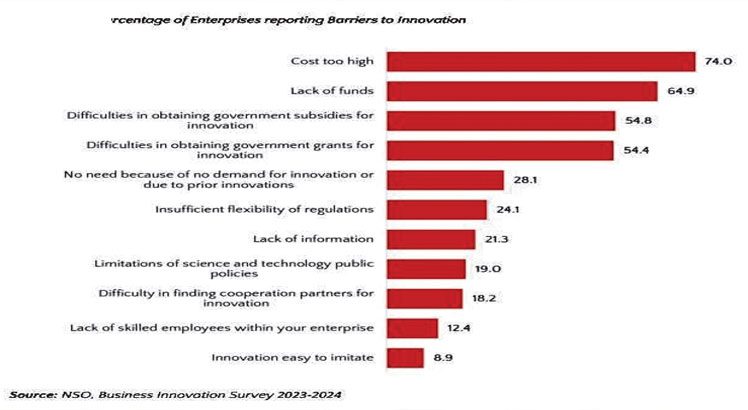
The first-ever survey, jointly conducted by National Statistical Office (NSO) and National Commission for Science and Technology, found that only 13.3 percent of enterprises received public financial support for innovation activities while 57.1 percent of businesses reported innovating between 2023 and 2024.
National Commission for Science and Technology director general Phillip Nyoni said in his statement accompanying the survey that the findings expose both the resilience and ingenuity of Malawian firms and the systemic bottlenecks that should be addressed to unlock their full potential.
He said the report should serve as a practical instrument for policy action to help refine industrial and innovation strategies, strengthen competitiveness and support inclusive growth, job creation and economic diversification as outlined in Malawi 2063 (MW2063) pillar number two which calls for a vibrant knowledge-based economy.
Said Nyoni: “This report presents empirical insights into innovation within a structural context often characterised by informality, limited research and development investment, low levels of intellectual property commercialisation, constrained access to finance, and fragmented institutional support systems.”
He said the survey marks an important step in strengthening innovation as a driver of inclusive growth, job creation and economic diversification.
NSO commissioner of statistics Shelton Kanyanda said the primary objective of the survey was to establish baseline information that would facilitate the monitoring of progress in enterprise innovation activities and offer valuable insights into the state of innovation within the country’s business sector.
“This marks a significant step in the country’s commitment to fostering scientifically and technologically-driven economic growth and development,” he said.
The Business Innovation Survey notes that innovation is central to improving enterprise productivity, competitiveness and efficiency, making it a key driver of the MW2063 agenda, the country’s long-term development strategy that seeks to transform Malawi into a lower middle-income economy by 2030 and an upper middle-income economy by 2063.
Despite 75.3 percent of enterprises identifying innovation as a strategic priority, only 36.7 percent reported having a formal innovation strategy while 24.6 percent had allocated a specific budget for innovation activities.
The survey also found that 58.4 percent of businesses that failed to access public financial support cited lack of information as the main reason, with 22.5 percent pointing to complex application procedures.
The information and communication sector recorded the highest innovation rate, with 97.3 percent of enterprises reporting innovation activities, followed by mining and quarrying at 84.2 percent and manufacturing at 74.1 percent. Professional, scientific and technical activities recorded the lowest innovation rate at 37.1 percent.